The series returns!
In January 2016, KaCSFFS member and notable board game collector David Means gave a presentation to the club about his collection. It was so interesting, I asked for permission to reprint it as a series of posts on this blog. He graciously agreed, and supplied me with his script. I have added the illustrations, hyperlinks, embedded videos, etc.
The first two posts in this series covered more general topics that cover many types of games. They were published on June 4, 2016, and June 18, 2016, and were well-received.
This next part of the series, which is scheduled to run into 2017, takes a closer look at one or more individual games. We hope you will continue to enjoy this series! --Jan S. Gephardt
Not Your Parents' Board Games
Part Three: Profile of the game Catan/Settlers of Catan
by David Means

A turn consists of possibly playing a development card, rolling the dice, everyone (perhaps) collecting resource cards based on the roll and position of houses (or upgraded cities) unless a 7 is rolled, turning in resource cards (if possible and desired) for improvements, trading cards at a port, and trading resource cards with other players.

IMAGES: Many thanks to Board Game Geek for the use of their corner logo, to Target for the CATAN game cover image, and to Board Game Quest for the image of a Settlers of Catan game board in play, and also a look at the Robber (from an informative review by Tyler Nichols). Many thanks to a page on the rules of the Settlers of Catan game (via the USC Student Computing Center) for the examples of development cards and the hand of resource cards. The "wood for sheep" hat meme is from Clever Move's enjoyable post, "Five Rules to Keep the Peace While Playing Settlers of Catan."
In January 2016, KaCSFFS member and notable board game collector David Means gave a presentation to the club about his collection. It was so interesting, I asked for permission to reprint it as a series of posts on this blog. He graciously agreed, and supplied me with his script. I have added the illustrations, hyperlinks, embedded videos, etc.
The first two posts in this series covered more general topics that cover many types of games. They were published on June 4, 2016, and June 18, 2016, and were well-received.
This next part of the series, which is scheduled to run into 2017, takes a closer look at one or more individual games. We hope you will continue to enjoy this series! --Jan S. Gephardt
Not Your Parents' Board Games
Part Three: Profile of the game Catan/Settlers of Catan
by David Means

I’m going to go over
some games that have come out in the last twenty years, each of which has a
different mechanic. Much of the information about the board games below came
from BoardGameGeek.com, a website dedicated to the hobby of boardgaming.
BoardGameGeek (BGG) has a database of well over sixty thousand games and
expansions, with a wealth of information about each game. You don’t need to
register to use the website, but you do if you want to comment or ask questions
in the forums. I’ve been a member since 2008 and my handle there is
“claymore_57”.
 |
| Current basic CATAN game cover. |
Catan (formerly The Settlers of Catan),
is a hand-management and route-building game in which players try to be the
dominant force on the island of Catan by building settlements, cities, and
roads. On each turn dice are rolled to determine what resources the island
produces. Players collect these resources (cards) -- wood, grain, brick, sheep,
or stone -- to build up their civilizations to get to 10 victory points and win
the game.
Setup includes randomly
placing nineteen large hexagonal tiles (each showing a different resource) in a
honeycomb shape and surrounding them with water tiles, some of which contain
ports of exchange. Number disks, which will correspond to die rolls (two
6-sided dice are used), are placed on each resource tile. Each player is given
two settlements (houses) and roads (sticks) which are, in turn, placed on
intersections and borders of the resource tiles. Players collect a hand of
resource cards based on which hex tiles their last-placed house is adjacent to.
A robber pawn is placed on the desert tile.
 |
| This is technically The Settlers of Catan. But the hexagonal setup is the same for all versions. |
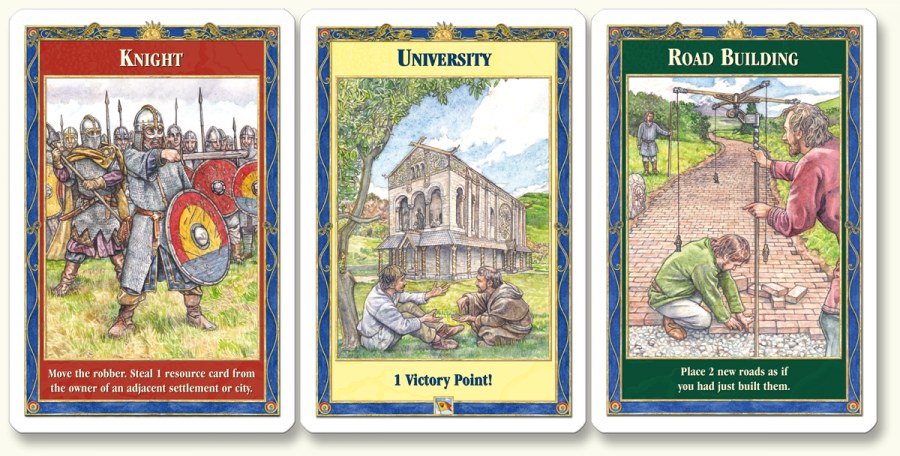 |
| Here are some examples of what development cards look like. |
A turn consists of possibly playing a development card, rolling the dice, everyone (perhaps) collecting resource cards based on the roll and position of houses (or upgraded cities) unless a 7 is rolled, turning in resource cards (if possible and desired) for improvements, trading cards at a port, and trading resource cards with other players.
 |
| A hand of resource cards. |
 |
| The Robber of Catan |
If a 7 is rolled, the active player moves the robber to a
new hex tile and steals resource cards from other players who have built
structures adjacent to that tile.
Points are accumulated
by building settlements and cities, having the longest road and the largest
army (from some of the development cards), and gathering certain development
cards that simply award victory points. When a player has gathered 10 points
(some of which may be held in secret), he announces his total and claims the
win.
Catan has won multiple awards and is one of the most popular games in recent history due to its
amazing ability to appeal to experienced gamers as well as those new to the
hobby.
It is also the game that gave us the in-game statement: “I’ve got wood
for sheep!”


